
The spreadsheet stopped carrying this months ago. Software development in Rwanda, built around how you actually work.
Custom inventory, POS, booking and dashboard software built around your specific workflow, not a SaaS subscription, not a template. Source code in your name, team training included, 90 days of post-launch support.
Built for the way Rwandan customers buy.
Inventory, POS or bookings, whichever you actually need
Your categories, your stock alerts, your rules. Multi-location and barcodes when you have them. We don't try to sell you a feature you won't use.
Built around your real workflow
We spend the first week inside your operation watching how it actually runs before writing a line of code. The system fits your team, not the other way around.
MoMo Pay and Airtel Money built in
If you're taking customer payments, MoMo and Airtel are wired into the checkout flow. If it's internal, we skip the payment layer entirely.
Source code registered to you
Delivered in a private Git repository under your GitHub organisation. Another Rwandan developer can pick it up six months later without paying us a license fee.
Training for up to five team members
In person in Kigali or on Google Meet. We don't leave until the team can run the software without us on speed-dial.
90 days of post-launch support
Bug fixes, small tweaks, questions answered on WhatsApp within four hours. After that, an optional retainer keeps things sharp.
Discovery week
We sit with your team, map the real workflow, list the things Excel keeps getting wrong.
Spec + fixed quote
Short written spec, fixed price, fixed timeline. You sign it; we start the next week.
Build in sprints
Two-week sprints with demos on staging. You test with real data early, not at the end.
Migration + training
Your existing data brought in cleanly. Hands-on training for up to five team members.
90 days of support
Bug fixes and small changes on WhatsApp. Then retainer or full hand-off. Your call.
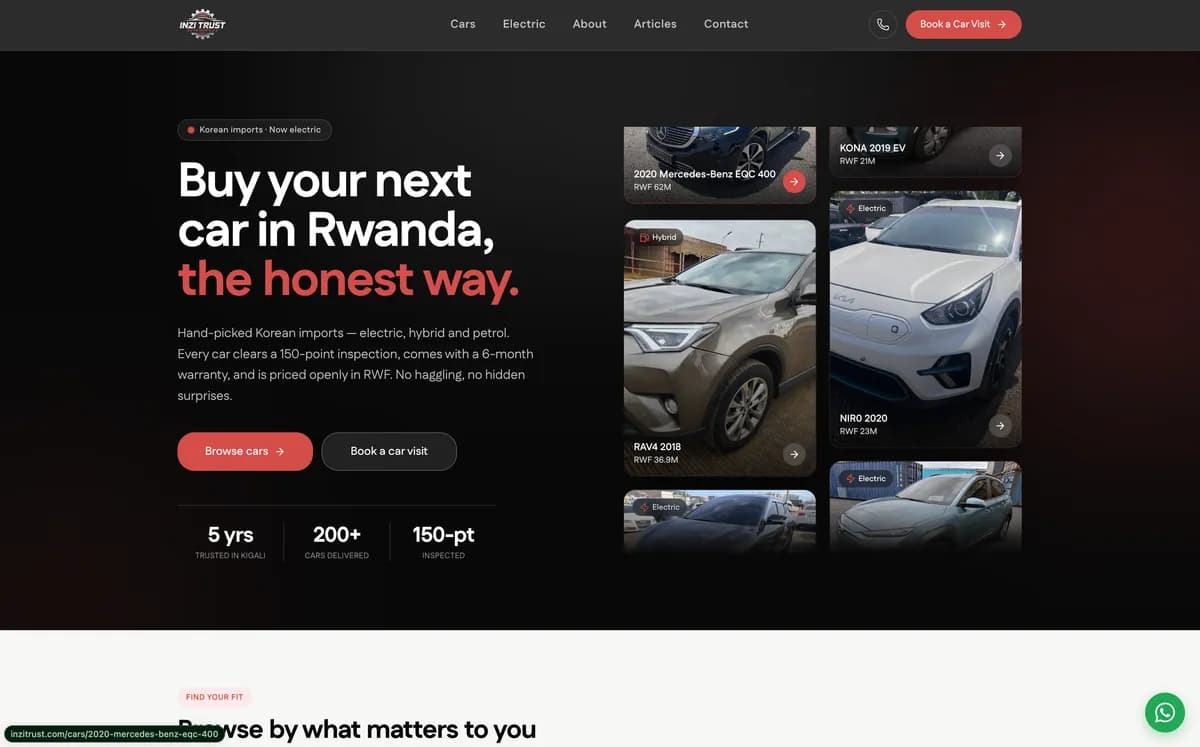
Inzi trust car selling website
A car-selling website for INZI Trust, a Kigali dealership bringing in Korean electric, hybrid and petrol cars. Open prices in RWF, every car inspected, and an easy way to book a showroom visit.

Royal Pets Center
Kigali's full-service pet shop, vet, grooming, and international pet relocation turned into a 344-product online store with same-day WhatsApp delivery and MoMo checkout.

Rubavu Market: Multi-vendor e-commerce and delivery platform
A live e-commerce and delivery platform connecting customers across Rubavu with every vendor inside Rubavu Modern Market one cart, MoMo and card payments held in escrow, same-day delivery.
Honest about who this is for.
- Manufacturers tracking raw materials, finished goods, and waste across multiple bins.
- Retailers running multi-location stock and POS who need one source of truth.
- Logistics and dispatch companies coordinating drivers, deliveries, and billing.
- Service businesses with bookings spread across three WhatsApp numbers and a notebook.
- Any SME whose spreadsheet has finally broken under the weight of the business.
Website development in Rwanda
Mobile-first sites with MoMo Pay, online ordering, custom domain. From 750,000 RWF.
Read moreRWANDASEO services in Rwanda
Google Business Profile, local SEO, citations and a review pipeline. From 150,000 RWF.
Read moreRWANDAMobile app development in Rwanda
An Android app with a web dashboard to manage it, MoMo + Airtel built in. Part of the Complete Business Build, from 6,500,000 RWF.
Read moreRWANDADigital marketing in Rwanda
SEO, Google Business Profile and the foundation underneath ad spend. From 150,000 RWF.
Read moreHow much does custom software cost in Rwanda?
Custom software is built as part of the Opus Complete Business Build, from 6,500,000 RWF over 90 days, which pairs the software with your website, store and a year of support. If you want to test the idea before committing, a Prototype Sprint is 500,000 RWF for a working prototype in 30 days, credited in full against the build if you go ahead. You get a fixed quote after the discovery workshop, never a vague estimate.
How long does it take to build custom software?
Single-module systems ship in 4–6 weeks. Larger systems with multiple modules and data migrations land in 8–12 weeks. We work in two-week sprints with a demo on a staging link at the end of each, so you see progress every two weeks, not a black box for three months.
Will I own the source code?
Yes. The Git repository is registered to your GitHub organisation. You can hire any other Rwandan developer to maintain or extend it later. We don't lock you into a license, a subscription, or our maintenance contract.
What stack do you build on?
Next.js for the frontend, Node.js for backend services, PostgreSQL or Supabase for the database, TypeScript across the stack, Docker for deployment. Boring, reliable, well-documented, the kind of stack any developer can pick up in 2030.
Can the software work offline?
Yes, where it matters. POS terminals and field-collection apps are designed to keep working when the internet drops, then sync the moment it's back. We test on real Kigali 3G, not just office wifi.
What happens after the 90 days of support?
Most clients move onto a monthly care plan (from 200,000 RWF/month for the Digitalization plan) for bug fixes, small features, and security updates as their business grows. If you'd rather take it fully in-house and hand it to your own developer, the source code and documentation are yours.
Send one message. Get an honest read in under four hours.
We'll tell you the scope, the cost, and the week we can start. No agency dance, no proposal PDF.